Footprints and Face Masks: 6 Ways ISF is Keeping Students Safe During Reopening
Footprints and Face Masks: 6 Ways ISF is Keeping Students Safe During Reopening
The date for when students will return to ISF learning centres in Steung Meanchey and Chbar Ampov is fast approaching. And when they return, they’re likely to notice a few changes we’ve made in an effort to protect them from COVID-19.
1. Daily Health Checks and 2. Personal Protective Equipment
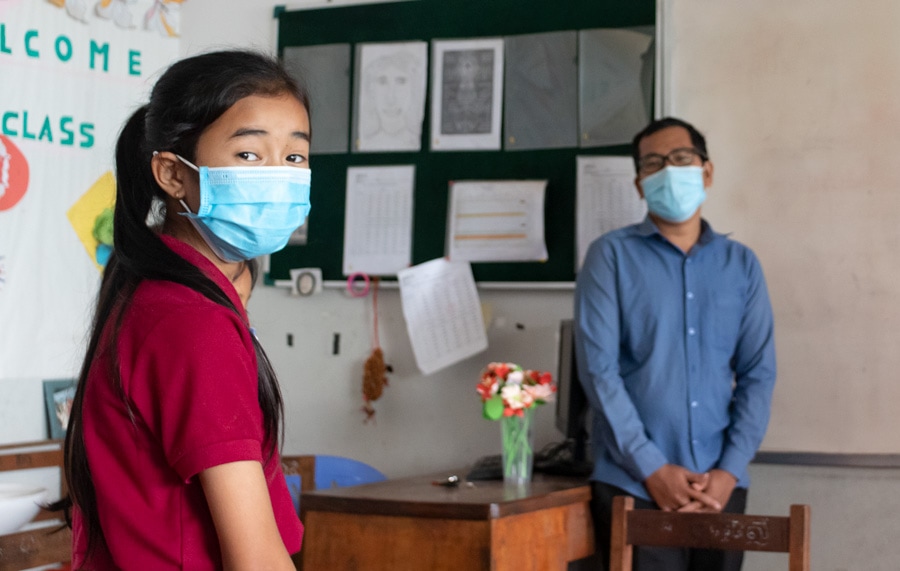
The first will be the mandatory temperature checks on arrival. And if any student’s temperature rises above 38°C, they are sent home to seek medical attention. It is now mandatory for students to wear face masks or face shields while on campus. If children haven’t brought their own mask when they arrive, they will be provided with one at the front gate.


Follow us on Facebook
Join us on our journey to provide opportunities for sport to over 3,500 underprivileged Cambodian children, as well as education, healthcare and nutrition to another 700.
Like our Facebook page to share in our successes, hear about events and find out how you can help these vulnerable youth.
3. Pathfinding and 4. Physical Distancing
Perhaps the biggest visual change they’ll see are the colourful painted footprints leading up and down every staircase and round every corridor. These might look like an art project, but they’re actually an innovative safeguarding measure. The direction of the steps shows students the correct paths to take around the school without colliding into each other and instantly undoing all attempts at physical distancing.

“It’s going to be hard for them to get used to it,” smiles Sambonin Khay, Operational Lead for the Steung Meanchey school. “After all, it’s taken us staff members a lot of getting used to. But we don’t ever want to have to close our gates again. So if we need to take extra steps to keep our students safe then that’s what we will do.”
The footprints venture into almost every corner of the school, including the gym area, where they show PE participants exactly where to stand and keep a safe distance from each other while exercising. “We know most schools aren’t going to be able to do any kind of PE or exercise classes at all because of COVID,” Sambonin says. “But promoting physical health is part of ISF’s DNA. It’s almost as important to us as good education, so we have to make it work. We are lucky to have a facility large enough that we can make physical distancing happen.”
5. Following Government Safety Mandates
Sambonin mentions the subject of luck frequently when talking about the school reopening efforts. Though, in reality, he and the ISF team have had to go to huge efforts to make the school ready and able to pass the Government’s stringent inspections.
But Sambonin reminds us of our good fortune in comparison to other schools in the area, claiming “Not only are our schools larger and more modern than most public schools, we also have nurses, which public schools don’t.” ISF’s nurses have always been crucial in maintaining good health among our students. Their efforts mitigate the high risks of contagion that most children in our Education Programme face from living in unhygienic and cramped urban areas. And their skills have become even more valuable in this time of heightened peril. The nurses – along with Bonin and some key education and sports staff – are at the core of the school’s new Health Committee.

Every ISF student has access to clean water for washing and drinking
6. Reduced Class Sizes
There is another enormous change that students and teachers will need to get used to. Until the risk of COVID-19 has been reduced, the Government is mandating face masks and social distancing within classes. That means that class sizes have been halved in most Cambodian schools and ISF is no exception. The result is a complex new schedule where students are taught in different shifts. This change has required substantial adjustment from the teaching staff, who have also been trained in monitoring students’ health to spot any signs of infection. Students who could show symptoms of infection will be sent home with proper advice provided by the nursing team. The consequences of an outbreak in the school could be devastating, so ISF will take no chances when it comes to the health of the wider student body.

Reduced class sizes mean that students are properly distanced and benefit from sneeze guards
Looking Ahead With Positivity
“It all sounds like it’s very serious and worrying,” Bonin says, “but actually the mood amongst the staff is cheerful. Everyone just wants to get back to work providing these children with the education they deserve.” After all, the sad reality is that many ISF students missed out on education when they were younger due to poverty or related challenges – that’s the reason they are enrolled in our Catch-Up Education Programme in the first place. During the school closures, ISF’s team worked hard to prevent these children missing out again by providing online lessons alongside weekly homework pick-ups and drop-offs. However, even the most rigorous and creative distance learning programme isn’t as effective as in-person learning.
“We’re happy to go to all these efforts because we believe in education,” Bonin says. “It can change these children’s lives, in fact it might be the only thing that can. Without it, most will live the rest of their lives trying to scrape a living from day to day. They will live without a plan and without choices. They deserve better and if that means we have to work harder and be more careful, that’s a small price to pay.”